
How Do Discount Codes Work in E-commerce Stores
Posted on |
How Do Discount Codes Work in E-commerce Stores? The Code’s Journey from Store to Cart
The Magic Behind Numbers and Letters
In the fast-paced world of e-commerce, discount codes or promo codes have become an indispensable part of the daily shopping experience. Who hasn’t been delighted to receive an extra discount when completing an online purchase? These codes, seemingly just a string of numbers and letters, hold immense marketing power, playing a pivotal role in attracting customers, stimulating sales, and building brand loyalty. But, have you ever wondered how discount codes work in e-commerce stores? What journey does this code take from its creation in the store until it’s applied to your shopping cart? In this article, we will unveil the complex yet simple mechanism behind these magical codes, exploring their technical and marketing aspects, and how both stores and consumers benefit from them in 2026.
What is a Promo Code and How Does it Differ from a Coupon?
Before diving into the details of how they work, it’s important to clarify the terminology. Terms like promo code, voucher code, and coupon are often used interchangeably, but there are subtle differences. Generally, a promo code refers to an alphanumeric string manually entered into a dedicated field during the online checkout process to receive a discount or a specific benefit. A coupon, on the other hand, can be a broader term encompassing both digital codes and traditional paper vouchers. In the context of e-commerce stores, the term promo code is often used to refer to the digital code that is entered .
The Technical Mechanism: What Happens Behind the Scenes When You Enter a Code?
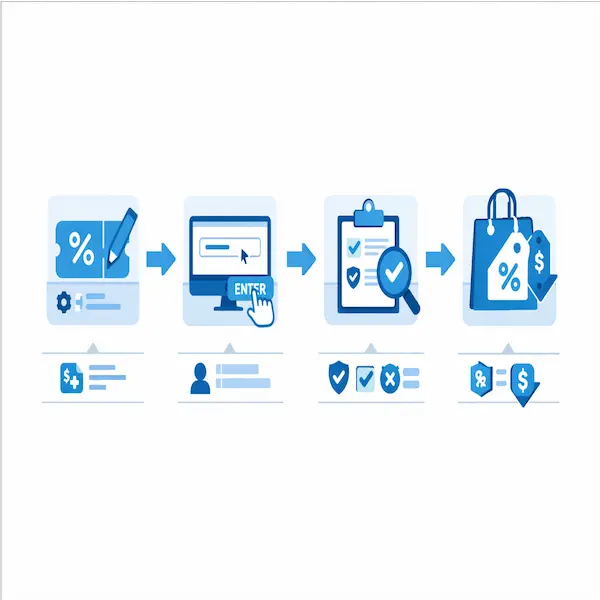
When a shopper enters a discount code in an e-commerce store, it’s not just about changing the final number in the shopping cart. Instead, a series of complex technical operations occur in the background to ensure the code’s validity and the correct application of the discount. This mechanism can be divided into three main stages:
Stage 1: Creation and Rule Definition (The Logic)
The journey begins when the store manager or marketing team creates the discount code through the e-commerce platform’s control panel (e.g., Shopify, WooCommerce, Magento). In this stage, a set of rules and conditions governing the code’s operation are defined, including:
•Discount Value: Is it a percentage discount (e.g., 15%), a fixed amount (e.g., $50), or free shipping?
•Targeted Products or Categories: Does the discount apply to all products, a specific category (e.g., women’s clothing), or a particular product?
•Minimum Purchase Requirement: Does the code require the total cart value to be above a certain amount to be activated?
•Validity Period: When does the code start and when does it expire?
•Usage Limits: Can the code be used once per customer, or multiple times? Is there an overall maximum number of uses for the code?
•Target Audience: Is the code available to everyone, only new customers, or specific existing customers (e.g., newsletter subscribers)?
•Combination with Other Offers: Can this code be combined with other existing discount codes or promotions?
All this information is stored in the e-commerce store’s database and linked to the unique discount code that will be distributed to customers .
Stage 2: Validation and Authorization
When a customer enters the discount code into the designated field on the shopping cart or checkout page, the e-commerce system performs the following steps:
1.Code Existence Check: The system searches the database to ensure that the entered code exists and is correct.
2.Validity Check: The system verifies that the code is still active and has not expired.
3.Usage Condition Check: The system reviews all predefined rules: Has the customer reached the minimum purchase amount? Does the code apply to the products in the cart? Is the customer eligible to use this code (e.g., not an old customer if the code is for new customers)? Has the code exceeded its maximum usage limit?
If all conditions are met, the code is considered valid, and the system proceeds to the next stage .
Stage 3: Calculation and Execution
After verifying the code’s validity, the system performs the following:
1.Recalculate Total: The specified discount (whether a percentage or a fixed amount) is applied to the total value of the eligible products in the shopping cart.
2.Display New Price: The shopping cart or checkout page is updated to display the new total price after applying the discount, showing the amount saved.
3.Record Usage: Upon successful completion of the purchase by the customer, the system records the code’s usage in the database. This recording is crucial for tracking the number of times the code has been used, updating remaining usage limits, and collecting analytical data .
Most Common Types of Discount Codes in E-commerce Stores
Discount codes vary to suit different marketing strategies and diverse objectives. Here are their main types:
•Percentage-Based Discount Codes: Offer a percentage off the total order value (e.g., 10% off all products).
•Fixed Amount Discount Codes: Offer a specific monetary amount off (e.g., $50 off your order).
•Free Shipping Codes: Waive shipping fees, which are highly effective in reducing shopping cart abandonment rates.
•Buy One Get One Free (BOGO) Codes: Allow customers to get a free product when they buy another, or a significant discount on the second product.
•New Customer Discount Codes: Aim to attract new customers and encourage their first purchase.
•Loyalty Codes: Offered to existing and loyal customers as a reward for their continued shopping with the store.
Why Do Stores Use Discount Codes? Marketing Objectives
Discount codes are a powerful marketing tool for e-commerce stores, used to achieve a wide range of objectives:
•Increase Sales and Convert Visitors into Customers: Discounts are a strong incentive that prompts hesitant visitors to make a purchase decision, thereby increasing conversion rates.
•Attract New Customers: Discount codes can be used as bait to attract customers who have not previously purchased from the store.
•Reward Loyal Customers: They help build loyalty and strengthen relationships with existing customers, encouraging them to return for repeat purchases.
•Clear Stagnant Inventory: An effective way to sell unpopular products or those nearing their expiration date.
•Promote New Products: Discounts can be offered on new products to encourage customers to try them.
•Collect Customer Data: When discount codes are used, stores can collect valuable data about customer behavior and preferences, which helps improve future marketing strategies.
•Recover Abandoned Carts: Sending discount codes to customers who left items in their cart without completing the purchase can encourage them to return and finalize the transaction .

Terms and Restrictions for Using Discount Codes: Why Doesn’t the Code Work Sometimes?
Some shoppers may encounter issues with a discount code not working, which is often due to not meeting one of the conditions or restrictions set by the store. The most important of these conditions include:
•Expiration Date: The code may have expired or not yet become active.
•Minimum Purchase: The required minimum cart value has not been reached.
•Targeted Products: The code does not apply to the products in the shopping cart.
•Usage Limits: The code may have already been used by the customer, or has reached its overall maximum usage limit.
•Target Audience: The code is intended for new customers while the user is an existing one, or vice versa.
•Exclusions: Certain products or brands may be excluded from the discount.
•Typographical Errors: Incorrectly entering the code (case sensitivity, extra spaces).
Therefore, it is always essential to read the terms and conditions associated with each discount code before attempting to use it to avoid frustration .
The Future of Discount Codes : AI and Personalization
The future of discount codes is heading towards greater personalization and intelligence, driven by advancements in artificial intelligence and data analytics. In 2026, we expect to see:
•AI-Powered Personalized Discounts: AI systems will analyze customers’ past purchasing behavior, preferences, and even website browsing to offer highly personalized discount codes to each individual, increasing their likelihood of use.
•Dynamic Discount Codes: Discount codes will be generated that change based on real-time factors, such as inventory levels, customer browsing behavior, or even weather conditions.
•Integration with Loyalty Programs: Discount codes will become an integral part of loyalty programs, where customers can redeem loyalty points for exclusive discount codes or receive automatic discounts based on their loyalty level.
•Predictive Marketing: Stores will be able to predict the optimal time to offer a discount code to a specific customer to incentivize a purchase, based on data analysis models .
Frequently Asked Questions (FAQ)
Q1: Are discount codes safe to use?
A1: Yes, discount codes are safe to use as long as you obtain them from reliable sources (the store itself, reputable coupon websites). Avoid suspicious codes or those that ask for unnecessary personal information.
Q2: Can I use more than one discount code in a single purchase?
A2: In most cases, stores allow only one discount code per purchase. However, some stores may permit combining certain codes in special offers, so you should always check the terms and conditions.
Q3: What should I do if the discount code doesn’t work?
A3: First, ensure you have entered the code correctly, and check the expiration date, minimum purchase, and applicable products. If the problem persists, contact the store’s customer service.
Q4: Do discount codes affect product quality?
A4: No, discount codes are purely a marketing tool and do not affect the quality of products sold in any way. Their purpose is to stimulate sales or reward customers.
Q5: How can I find the best discount codes?
A5: Subscribe to your favorite stores’ newsletters, follow their social media accounts, and visit specialized coupon aggregation websites that display the latest offers.
Conclusion
In conclusion, it is clear that discount codes are not just fleeting marketing gimmicks, but an essential part of the e-commerce infrastructure, operating with a precise technical mechanism and serving multiple marketing objectives. They are a bridge connecting the consumer’s desire for savings with the store’s goal of increasing sales and building loyalty. With continuous advancements in AI technologies, we expect these codes to become even smarter and more personalized, enhancing their effectiveness for both sellers and buyers.
Don’t miss out on savings! Start now by searching for discount codes for your favorite products and enjoy a more economical shopping experience. And if you are an e-commerce store owner, invest in understanding and intelligently applying discount code strategies to turn your visitors into loyal customers and boost your profits!
References: