Digital vs. Paper Coupons: What’s the Difference
Posted on |
Digital vs. Paper Coupons: What’s the Difference and Which is Better for You?
From Paper Scissors to Smartphone Screens
In the ever-evolving world of shopping, coupons have become an integral part of the consumer experience, whether the goal is to save money or discover new products. With the digital transformation sweeping the globe, coupons have evolved from their traditional paper form to their modern digital counterparts. This evolution has raised questions about the fundamental differences between the two types, and which offers greater value to shoppers and stores alike. Do paper coupons still hold their ground, or have digital coupons won the battle? In this article, we will delve into answering the question: What’s the difference between digital and paper coupons in shopping?, exploring the advantages and disadvantages of each, and which best suits your needs in 2026.
What Are Paper Coupons (Traditional Paper Coupons)?
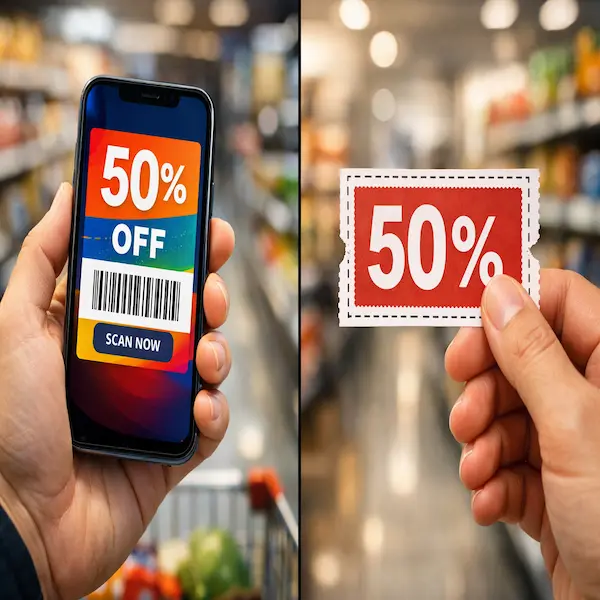
Paper coupons are the traditional form of coupons that consumers have been accustomed to for decades. These coupons are typically printed in newspapers, magazines, advertising flyers, or sent via direct mail. To use them, the consumer cuts out the coupon and presents it at the point of purchase in a physical store to receive the advertised discount. These coupons are characterized by their tangible feel and familiarity to a wide segment of consumers, especially older generations .
What Are Digital Coupons (Digital Coupons)?
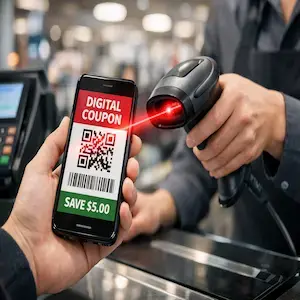
With the spread of the internet and smartphones, digital coupons have emerged as a modern and effective alternative to paper coupons. These coupons are essentially digital discount codes or QR codes that can be accessed via smartphone apps, websites, emails, or social media. The discount is applied by manually entering the code during online checkout, or by scanning a QR code with a smartphone in a physical store. Digital coupons offer ease of access, traceability, and flexibility in use .
Key Differences: Digital vs. Paper Coupons
The differences between digital and paper coupons are numerous and can be summarized in several key points:
Ease of Access and Use
|
Feature
|
Paper Coupons
|
Digital Coupons
|
|
Access
|
Requires searching in newspapers, magazines, or direct mail.
|
Easily accessible via internet, apps, email.
|
|
Usage
|
Requires cutting out the coupon and physically presenting it in-store.
|
Enter a code or scan a QR, usable online or in-store.
|
|
Carrying & Storage
|
Can be cumbersome to carry and organize.
|
Easy to store on a smartphone or digital accounts.
|
Cost and Production
Paper coupons are more expensive to produce and distribute, as they require printing and physical distribution. In contrast, digital discount codes are significantly less costly to create and distribute, making them an attractive option for stores looking to reduce operational expenses .
Tracking Accuracy and Data
Digital coupons significantly outperform in terms of traceability and data collection. Stores can track the number of times a coupon is used, the products purchased, and even the demographics of customers who used it. This valuable data helps stores improve their future marketing strategies. Paper coupons, on the other hand, provide very limited data about their usage.
Environmental Impact and Sustainability
Paper coupons contribute to paper consumption and waste, making them less environmentally sustainable. In contrast, digital coupons are more environmentally friendly, as they do not require any paper resources or printing processes, thereby reducing the carbon footprint .
Pros and Cons of Each Coupon Type
Each type of coupon has its advantages and disadvantages, making it suitable for specific scenarios:
Paper Coupons: Nostalgia and Tangible Feel
Pros:
•Ease of Use for Seniors: Requires no technical knowledge, making them preferred by some demographics.
•Wide Reach: Can reach an audience that does not extensively use the internet.
•Tangible Feel: Some consumers prefer the physical feel of a coupon and the act of cutting it.
Cons:
•High Cost: Printing and distribution costs are high.
•Difficulty in Tracking: It is difficult to accurately track their effectiveness.
•Limited Reach: May not effectively reach all target customers.
•Not Environmentally Friendly: Contributes to paper waste.
•Prone to Loss or Forgetting: Can be easily lost or forgotten.

Digital Coupons: Speed and Artificial Intelligence
Pros:
•Easy Distribution: Can be sent via email, text messages, or social media quickly.
•Accurate Tracking: Provides detailed data on usage and performance.
•Effective Targeting: Can target specific customer segments based on their purchasing behavior.
•Environmentally Friendly: Does not consume paper resources.
•Resistant to Loss: Stored digitally on phones or accounts.
•Flexibility in Modification: Terms can be easily modified or canceled.
Cons:
•Requires Technical Knowledge: May be difficult for some seniors or those without smartphones to use.
•Internet Connection Issues: Requires an internet connection for use in some cases.
•Privacy Concerns: May raise concerns about personal data collection.
Statistics: Consumer Trends in Coupon Usage
Recent statistics for 2026 indicate a clear shift towards favoring digital coupons. According to some studies, 67% of consumers use digital coupons, while 59% still use paper coupons. More interestingly, 57% of shoppers prefer digital coupons over paper ones, and digital coupon redemption rates can be up to ten times higher than paper coupons . This does not mean that paper coupons have completely disappeared; they still hold value in certain sectors or among specific consumer segments.
Which is Better for the Store? And Which is Better for the Shopper?
The choice of the best coupon type depends on the specific goals of both the store and the shopper:
•For the Store:
•Digital Coupons: Ideal for e-commerce stores and businesses that want precise targeting, performance tracking, and reduced operational costs. They are also excellent for building email lists and enhancing social media engagement.
•Paper Coupons: May be preferred by small traditional stores targeting a local community, or businesses looking to reach an audience that does not extensively use technology. They can also be effective in direct mail campaigns.
•For the Shopper:
•Digital Coupons: Offer ease of access, flexibility of use, and a wide variety of offers. Ideal for shoppers who prefer online shopping and those looking for maximum savings and convenience.
•Paper Coupons: May be suitable for shoppers who prefer simplicity, do not own smartphones, or enjoy the traditional coupon-cutting experience.
Tips for Integrating Both Types into a Single Shopping Strategy
To maximize benefits, stores and consumers can integrate both digital and paper coupons into a single strategy:
•For Stores: Paper coupons can be offered in physical stores to attract customers, while exclusive digital discount codes are provided for online shoppers or newsletter subscribers. This hybrid approach ensures reaching the widest possible customer segment.
•For Shoppers: Paper coupons can be utilized for local offers or daily products, while digital saving vouchers are sought for larger deals or online purchases. Combining both ensures maximum savings.
Frequently Asked Questions (FAQ)
Q1: Will paper coupons completely disappear?
A1: Despite their declining popularity, paper coupons are unlikely to disappear completely. They still hold their place in some markets and demographics and may continue as part of hybrid marketing strategies.
Q2: Are digital coupons safer than paper ones?
A2: Generally, yes. Digital coupons are less prone to fraud or unauthorized use due to advanced tracking and verification systems. However, caution should be exercised with suspicious links or unrealistic offers.
Q3: How can small businesses benefit from digital coupons?
A3: Small businesses can easily benefit from digital coupons through e-commerce platforms that provide tools for creating and managing coupons, or through low-cost email and social media campaigns.
Q4: Are there any disadvantages to using digital coupons for consumers?
A4: Disadvantages may include the need for a smartphone and internet connection, privacy concerns related to data collection, and the possibility of missing out on offers if the consumer is not actively following stores.
Conclusion
In conclusion, it is clear that both digital coupons and paper coupons have their place and value in the world of shopping. While digital coupons are gaining prominence due to their ease, flexibility, and traceability, paper coupons still retain their traditional charm and reach a specific audience. The key is to understand the differences and leverage the advantages of each type to achieve maximum savings for shoppers and boost sales growth and customer loyalty for stores.
Whether you prefer cutting coupons from newspapers or scanning them with your smartphone, the world of savings awaits you! Start today by exploring the best available offers, and don’t miss out on saving money. And if you are a store owner, consider a hybrid coupon strategy that combines the best of both worlds to boost your business!
References: